


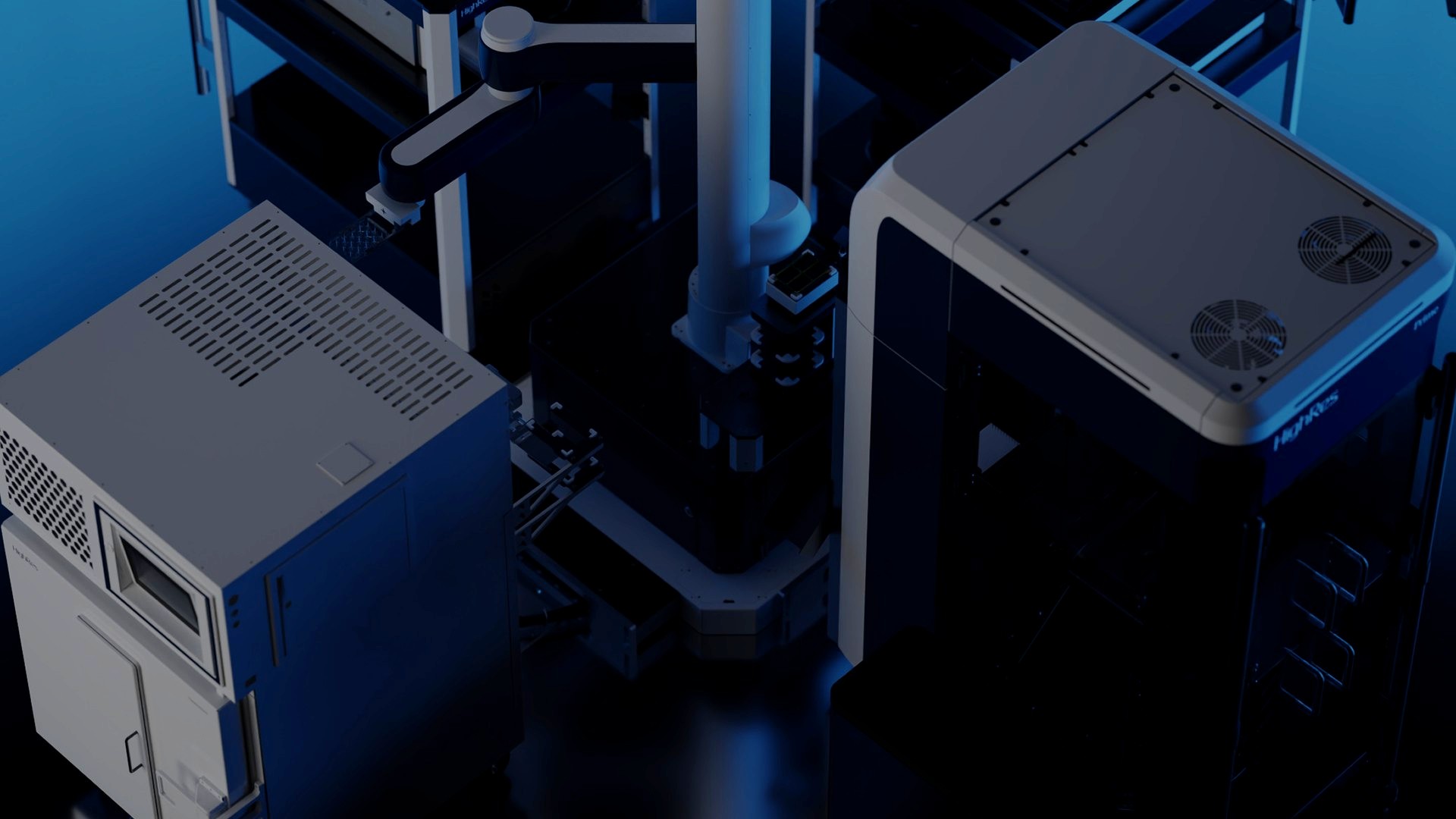
The Connected Lab


The Investments Are Real, The Connections Aren't
Over the past decade, life science organizations have made two large, separate investments in the future of how they do science. One has gone into the enterprise digital stack: cloud platforms, data lakes, electronic lab notebooks (ELNs), laboratory information management systems (LIMS), and increasingly, AI and machine learning capabilities. The other has gone into the lab itself: instruments, liquid handlers, robotics, sample storage, and automated work cells designed to industrialize what was once manual bench work.
On paper, these two investments should produce a connected scientific enterprise, one in which data flows continuously from instruments to insight, and in which AI models close the loop back to experiments. In practice, they rarely do. Executives recognize the symptoms:
- Fragmented data that they cannot unify across sites or after an acquisition
- Turnaround times that are too slow to defend
- Hidden operating costs
- Scientific decisions that stall because the underlying data cannot be trusted
This paper makes a simple argument. The disconnect is not primarily a tooling problem, a vendor problem, or a culture problem. It is an architecture problem. A modern lab is a stack of four layers: instruments, orchestration, data fabric, and analytics. Most organizations have invested in the top and the bottom layers while leaving the connections between them as team responsibilities. No single purchase fixes a disconnected lab. The capital deployed on either end underperforms until that architecture exists.
No single purchase fixes a disconnected lab. Before you lay a single brick, you need an architecture that treats all four layers as one system.
There is a reason this matters more now than it did three years ago. AI and modern informatics are compressing the Design and Analyze halves of the R&D loop from months into weeks. As those halves speed up, the bottleneck moves to Make and Test, the physical lab. An AI strategy is now only as fast as the lab that can feed it, which is what turns a connected lab from a nice-to-have into the rate-limiting step.
We propose a four-layer model that names each layer, locates it correctly in the stack, and clarifies how they connect. We call it the Digital Lab Maturity Model (DLMM). The DLMM is the basis for a maturity matrix, a structured assessment we use inside customer engagements to benchmark where a lab is today and chart where it should go next. The DLMM gives executives a set of decision questions that they can take into their next planning cycle. It is also the lens through which we believe the biggest open question in the industry, the move from AI pilots to AI in production, should be evaluated.
The practical output of this model is the Connected Lab Maturity Benchmark: score the four layers, find the seams that are limiting AI readiness and turnaround, and leave with the highest-leverage moves to make next.
The argument of this paper is focused on the success of an organization's scientific and data goals: that a connected lab is achieved only when instruments, orchestration, data fabric, and analytics are designed together, as a single strategy.
The paper is written jointly by HighRes, the lab automation company behind the Cellario OS orchestration platform, and Involve Data, a data strategy firm focused on digital and AI architecture. We have written it together because the connected lab spans both of our areas of expertise, from robot arms to enterprise data and AI infrastructure, and because the customers who feel this gap most acutely are the ones for whom neither a pure vendor nor a pure consultancy can give a complete answer.
01. The Diagnosis: Symptoms Executives Recognize
Conversations with senior life science leaders about digital transformation tend to circle a recognizable set of complaints. The complaints are not unique to any one company, therapeutic area, or stage of growth. They show up in discovery biotechs and in the digital steering committees of top-twenty pharma. They are remarkably consistent.
The day to day user feels a broken integration or tools that do not talk to each other; the senior leader feels a decision they cannot make, a cost they cannot see, or a timeline they cannot defend. Here, we give language to what you are experiencing. In the next section, we argue that they all trace to a single underlying cause.
"I cannot get a holistic picture from our data."
A common executive frustration is fragmentation impacting decision making. Research happens on islands, by site, by team, by acquired company, and each island has its own conventions, its own systems, and its own idea of what a result looks like. Leadership cannot get a unified picture across them. The frustration sharpens after an acquisition when leadership discovers the acquired company's data cannot be used without substantial integration work, or during a program readout, when the team cannot quickly pull the full picture together in a summary. This is not a complaint about a single tool. It is a complaint that the organization has no common way to make its data cross-comparable, and therefore no way to reason about its science as a whole.
"Our turnaround time is too slow, and I can't prove the investment paid off to get us to discovery faster."
Executives track turnaround time (TAT) and iteration speed because those numbers tie directly to cost, to competitiveness, and to whether a capital investment was justified. When a workflow is automated, the question that comes back is immediate and quantitative: what was the change in TAT, and was the investment worth it for speed to discovery? Leaders are asked to defend these numbers on a regular cadence. When the lab and the digital stack are disconnected, TAT is both slow and tedious to measure, which means the investment case is harder to prove after the fact.
"I don't actually know what this really costs to run."
Any lab can produce a budget: reagents, instrument depreciation, service contracts, headcount. That arithmetic is the easy part. The costs that never reach a line item are the ones that distort the picture, and most of them are time: hours spent hunting for a prior result across shared drives and notebooks, data reformatted and reconciled by hand before the real analysis starts, experiments re-run because the earlier data could not be found or trusted, protocols executed manually because the instruments were never connected to anything. None of this shows up as a discrete expense; it is absorbed into salary lines that read as fully productive. Therefore the true cost of an assay, a workflow, or a lab is consistently understated, and leaders benchmark performance and justify investments against a number that leaves out a large, hidden component, limiting an organization's ability to effectively forecast.
"I can't make the call because I don't have the data I need."
In a research lab, a decision is only as sound as the data behind it, and data is only trustworthy when its full provenance is intact: which assay ran, on which samples, under what conditions. When any of that chain is missing or reconstructed after the fact, the result cannot be defended, and the decision it was meant to support defaults to intuition instead of evidence. The cost is not a flawed report. It is a program continued that should have been killed or vice versa.
"We spent a fortune on the lab, and it is not paying off."
Perhaps the most straightforward frustration is at the level of digital strategy and finance. A lab has invested heavily in automated instruments and, separately, in a modern ELN, LIMS, and cloud platform, yet the path between them still runs through manual export, brittle scripts, and a scientist copying values into a spreadsheet. To a leader who signed off on both investments, this is the visible proof that the pieces were never connected into a system. It also quietly caps throughput, inflates cost, and slows turnaround, the three things the boardroom is measuring. When the time comes to invest in a new instrument, a new platform, or a new piece of digital infrastructure, the decision is made narrowly, by the team that will use the tool, against criteria that the tool itself defines. There is rarely a coherent picture of how the new investment will fit into the existing stack, what assumptions it makes about adjacent layers, or what new dependencies it creates.
Years of tool-by-tool decisions accumulate into an estate that no one designed and no one fully understands.
Each of these frustrations has its own vendors offering relief, better dashboards, better integrations, better LIMS, better AI, better instruments. None is wrong on its own. But none addresses the structural cause, and beneath all of them sits a single problem: the organization has no coherent strategy for its data and the lab that produces it. To see that cause clearly, we need a model.
[Truncated]
........


