


Building Benchling Around Your Science: The Data Foundation AI Depends On


In this four-part series, we share how Involve Data helps scientific teams build a Benchling implementation they can use, maintain, and extend. We start with the data model, then explore preserving scientific context during migration, connecting workflows with Benchling Apps, and supporting the team as its science evolves. The same decisions determine whether the data is ready for analysis and AI later.
Every scientific team brings its own methods, materials, and questions to Benchling. A useful implementation needs to reflect those details: what the team is studying, how its data connects, and how that information will be used next.
That starts with the data model. Decisions about what to register, which metadata to capture, and how records relate shape everything built afterward, from everyday data entry to automated workflows and analysis.
At Involve Data, we work through those decisions with the people doing the science. We ask detailed questions, look at actual working files, and map the relationships together. Our experience at the bench helps us understand the answers. Our data and technology expertise helps us turn them into a model the team can build on.
Ask the Questions That Define the Model
We ask questions that can feel obvious because the answers affect the design. What does your team mean by a sample? Does this identifier refer to a material, a particular lot, or a container? Which assay produced this result, and which sample or lot was tested? Which information needs to travel with it when another team takes over?
Experience gives us familiar patterns to draw on. Those detailed conversations tell us how to apply them to a client's science. They help us agree on what each record represents, which attributes belong to it, and what scientists need to find later.
Assess the Model and Gather the Requirements
For a client with an existing Benchling tenant, we assess the data model against best practices and review the actual data. We built an AI-assisted tool that can compare the tenant with our assessment guide, giving us a first pass to investigate. Our team then examines the findings and works through their meaning with the client.
In parallel, we gather the documents people use in their work, including certificates of analysis, raw instrument data, and Excel files. We ask how information moves between teams, what matters at each handoff, and what the data science team will need for analysis. Those answers shape the metadata and relationships the model needs to capture.
When a project involves data that has not been captured before, we define the model with the client. We start with the workflows the team needs to implement first and consider how later work will use the same records.
Assessment and requirements gathering inform each other. A field that looks complete in the configuration may need more context once we see how the team uses it. A working file may reveal a relationship that the proposed model needs to include.
"Decisions about what to register, which metadata to capture, and how records relate shape everything built afterward."
Make the Relationships Visible
We use Lucidchart to map the connections between records so scientists and technical teams can review the design together. Seeing the relationships makes it easier to discuss what belongs where and how one part of the workflow connects to the next.
For example, a protein complex, its component chains, and the lots produced by a contract research organization are related but distinct. The model needs to represent those differences and show how the records connect. That structure determines what can be reused and where new information belongs.
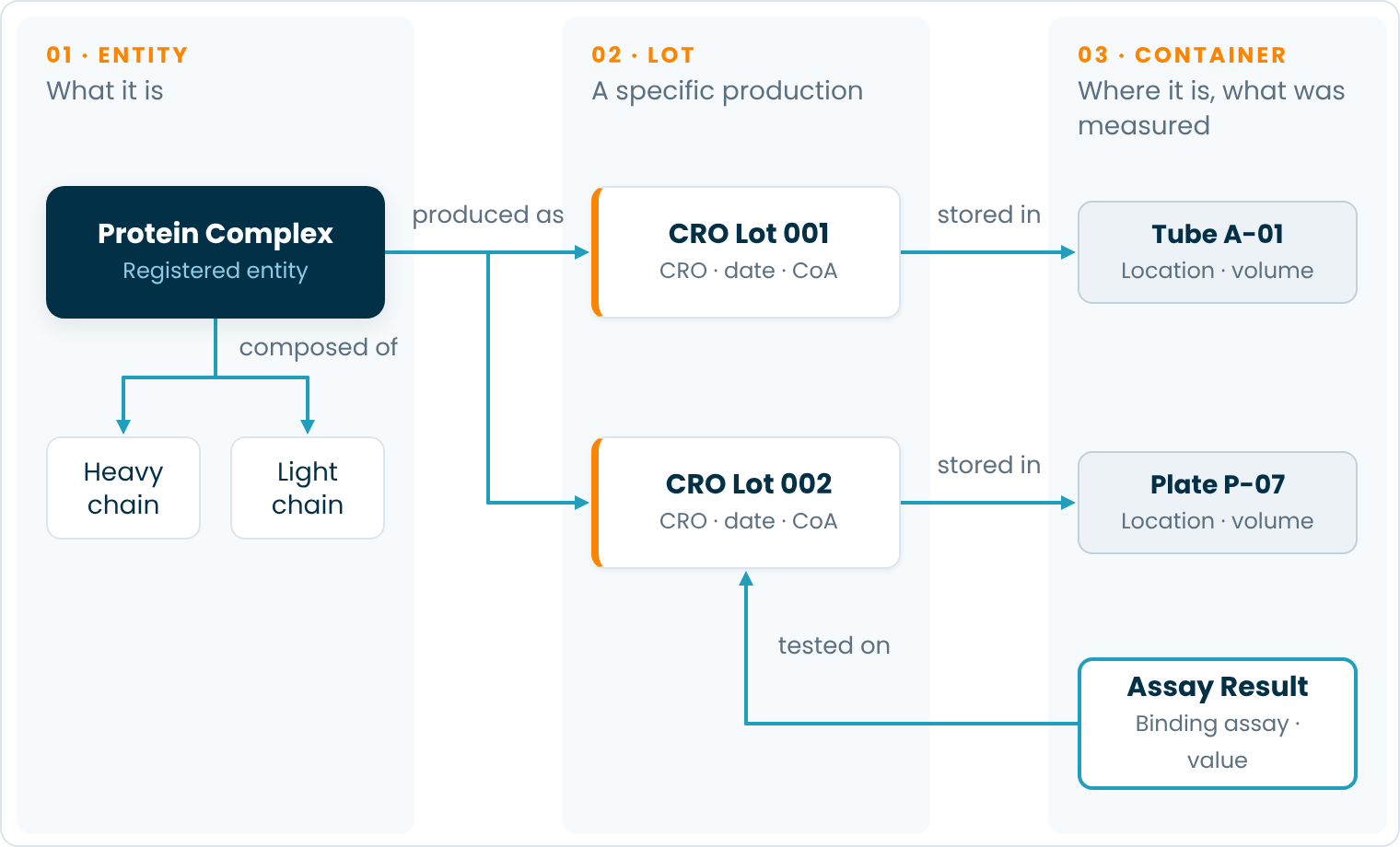
We refine the design as those conversations develop. A proposed relationship may raise another question; a real data file may change an assumption. Working through those details together is how the model becomes specific enough to guide the implementation.
Give the Implementation a Clear Starting Point
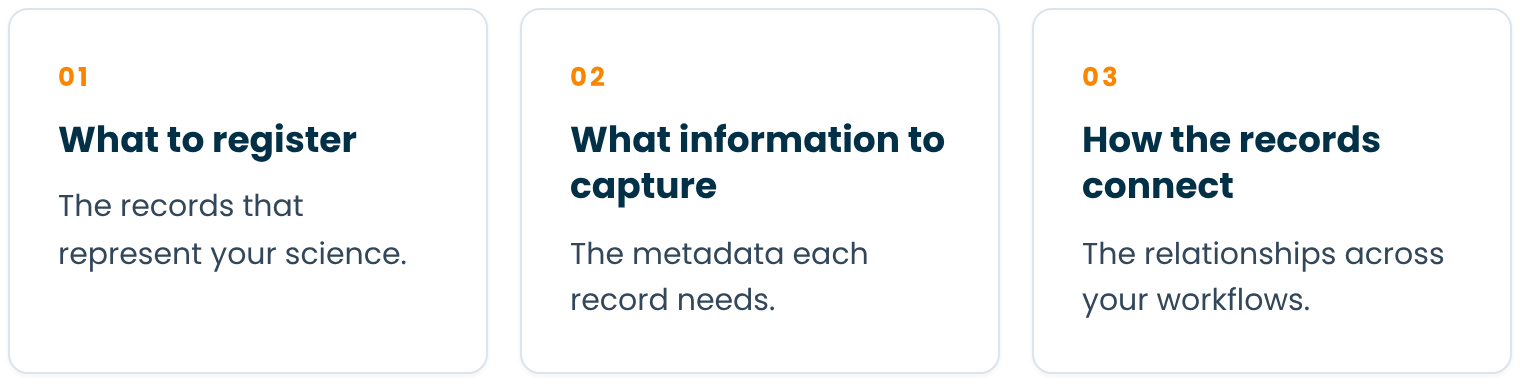
These decisions set priorities for configuration. For an existing tenant, the assessment also identifies gaps and recommended improvements.
This is why we invest in the foundation. A shared understanding of the science gives configuration, data capture, and integration work a clear direction. It also lets the team resolve design questions before more records and workflows depend on those decisions. AI tools can only reason over what the model captured. A record with clear identity, complete metadata, and explicit relationships is one an AI can use; a spreadsheet of loosely named samples is not.
Build on the Foundation
In Part 2, we explore moving legacy data into Benchling while preserving its scientific context. Part 3 shows how Benchling Apps put the data model to work through connected workflows.
Whether you are planning a new Benchling implementation or extending an existing one, we can help you define the foundation it needs. We start with your science and scope a practical first step with your team.
Meet Involve Data at Benchtalk on October 15–16, 2026 to talk through your Benchling implementation.


